Project Firstline
About Project Firstline
Strengthening infection prevention and control in urgent care.
What Project Firstline is
Project Firstline is the Centers for Disease Control and Prevention's (CDC) national training collaborative for healthcare infection control. The initiative provides healthcare workers with practical, accessible education to help them understand how infections spread, how to recognize infection risks, and what actions they can take to protect themselves, their patients, and their teams.
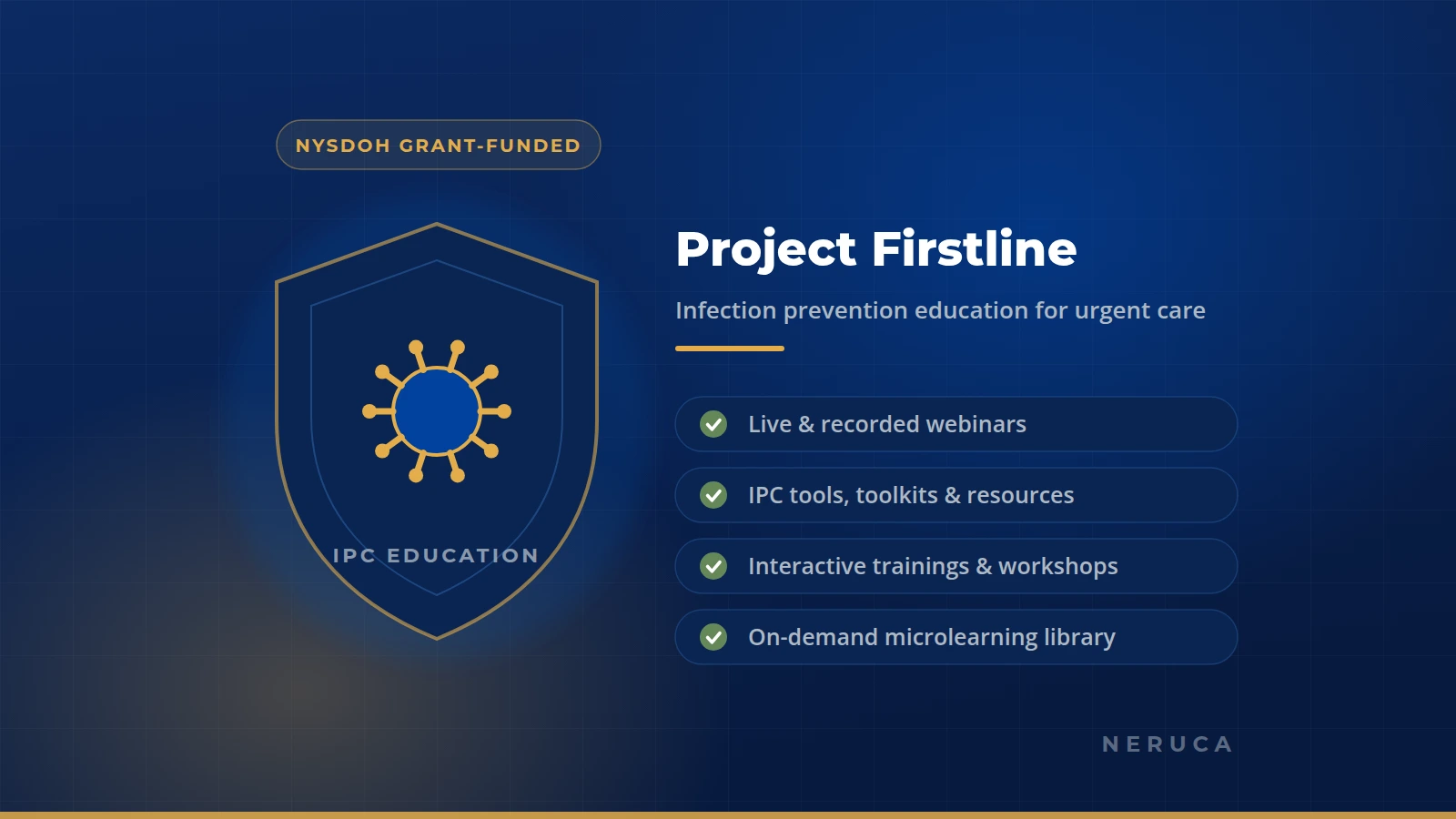
Through grant funding from the New York State Department of Health, the Northeast Regional Urgent Care Association (NERUCA) is bringing Project Firstline education and resources directly to the urgent care community.

A national collaborative
Led by the Centers for Disease Control and Prevention (CDC).
Grant funded
Supported through grant funding from the New York State Department of Health.
Built for urgent care
Delivered by NERUCA for the clinical and operational realities of urgent care.
The programme in numbers
- 0
- Webinars in the monthly series
- 0
- Workshops, plus a live capstone
- 0
- Tools, checklists and templates
- Free
- For NERUCA members
Education designed for the urgent care environment
Urgent care teams play an important role in identifying and responding to infectious disease threats. NERUCA's Project Firstline initiative is designed specifically with the urgent care environment in mind — providing relevant, practical infection prevention and control education that can be applied across clinical and operational settings.
Webinars
Live and recorded educational webinars.
Tools and resources
Infection prevention and control tools and resources.
Microlearning
Short, on-demand learning opportunities.
Workshops
Interactive trainings and workshops.
Preparedness
Resources focused on emerging infectious diseases and emergency preparedness.
A learning library
A growing library of infection prevention education for urgent care teams.
Join an upcoming training
NERUCA offers Project Firstline webinars and educational events throughout the year, featuring experts in infection prevention, infectious diseases, emergency preparedness, and urgent care.

Project Firstline IPC Training Series
8 sessions · June 2026 – January 2027
Every session ships with practical tools you can put to work the same week, and closes with a knowledge check and a participant evaluation.
See the full seriesNext up
- 30AUGWebinar #2Respiratory Pathogens
Airborne IPC: Measles as a Case Study
August 30, 2026
Airborne infection prevention and control in an urgent care setting, with measles as the worked example: catching it at the front desk, isolating quickly, and handling exposures after the fact.
- 17SEPWebinar #3Emergency Preparedness
Preparing for the Next Outbreak: Ebola as a Case Study
September 17, 2026
High-consequence pathogen and outbreak preparedness for centers that will see the first patient before anyone else does — identification, immediate response, and the plan you need on the shelf beforehand.
- 30SEPWebinar #4IPC Basics
Triage, Screening & Isolation in Urgent Care
September 30, 2026
The single most requested topic in NERUCA's learning needs assessment: recognizing communicable disease at the point of entry and getting source control in place before it moves through the waiting room.
Registration is handled by the host — each session opens its own registration page. See all sessions.
Project Firstline at the CDC
Project Firstline provides free infection control education, training materials, toolkits, and resources for frontline healthcare workers nationwide.
- Infection control education
- Training materials
- Toolkits
- Resources
Stay connected
New trainings, tools, and resources throughout the year.
Stay connected with NERUCA for new Project Firstline trainings, tools, and resources as they become available — and join the association working on urgent care's behalf across all nine states.
Project Firstline is a national collaborative led by the Centers for Disease Control and Prevention (CDC). NERUCA's Project Firstline activities are supported through grant funding from the New York State Department of Health.